Photographing the solar eclipse 2015
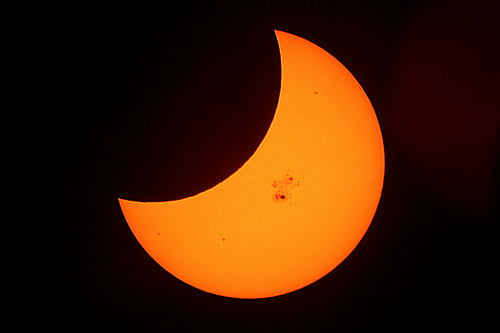
This Friday, 20th march 2015, there is going to be a total solar eclipse across the far Northern regions of Europe and the Artic. The longest duration of totality for this eclipse will be 2 minutes and 46 seconds as viewed off the coast of the Faroe Islands. This will mark the last total solar eclipse in Europe for over a decade.
The next not being until August 12, 2026
Here is the map of where the total eclipse will be visible:
Up to 40% of the sun is covered.
Note: Percentage values (%) relate to moon coverage of the sun and depends on location. Visibility is weather permitting.
When watching the total solar eclipse, be aware of your eyes!
Never look directly into the sun without proper protection!
Photographing the solar eclipse 2015
If you want to photograph the solar eclipse, what things do you have to consider?
Lens choice:
Actually any lens will do. It all depends on what you are looking for in your image.
When shooting wide angle it can be great to incorporate animals in your pictures (some will go back to their barns, because it’s getting dark).
If you want to have a nice view of the total eclipse and the corona you should be shooting with 400-600 mm on a full frame camera.
Camera settings:
Here it is getting tricky. In the beginning of the eclipse you would probably need a really fast shutter speed, exceeding your camera maximum shutter speed.
You could crank up the aperture to something like f/22 or even higher but that will only result in poor quality photo’s.
What you should be doing is attaching ND filters to your lens. Maybe even stacking a few.
A 10 stop ND filter or even a 15 stop ND filter (stacked) will be sufficient during the beginning of the solar eclipse.
As the moon is holding back more and more sunlight, the ND filters can be reduced. And when you have the total eclipse, than you should be shooting without any ND filters on your lens.
You can test your settings by taking a few test shots an hour before sunset.
Be aware not to look through your viewfinder! Use live view!
Focussing:
Turn off auto focus.
Focus your lens to infinity or if you don’t have the markings on your lens, focus to something distant and than revert to manual focus.
Because of the light and low contrast the autofocus will be hunting from back to front.
Weather:
Clear blue skies can be nice if you want to shoot a sequence, but few clouds will be very interesting as well!
I hope you have good weather! The weather forecast here is terrible, with complete overcast skies 🙁
Please let me know how your solar eclipse was in the comments!
Here are some inspirational images from the internet:
“Ecl-ann” by sancho_panza (flickr)




Leave a Reply
Want to join the discussion?Feel free to contribute!